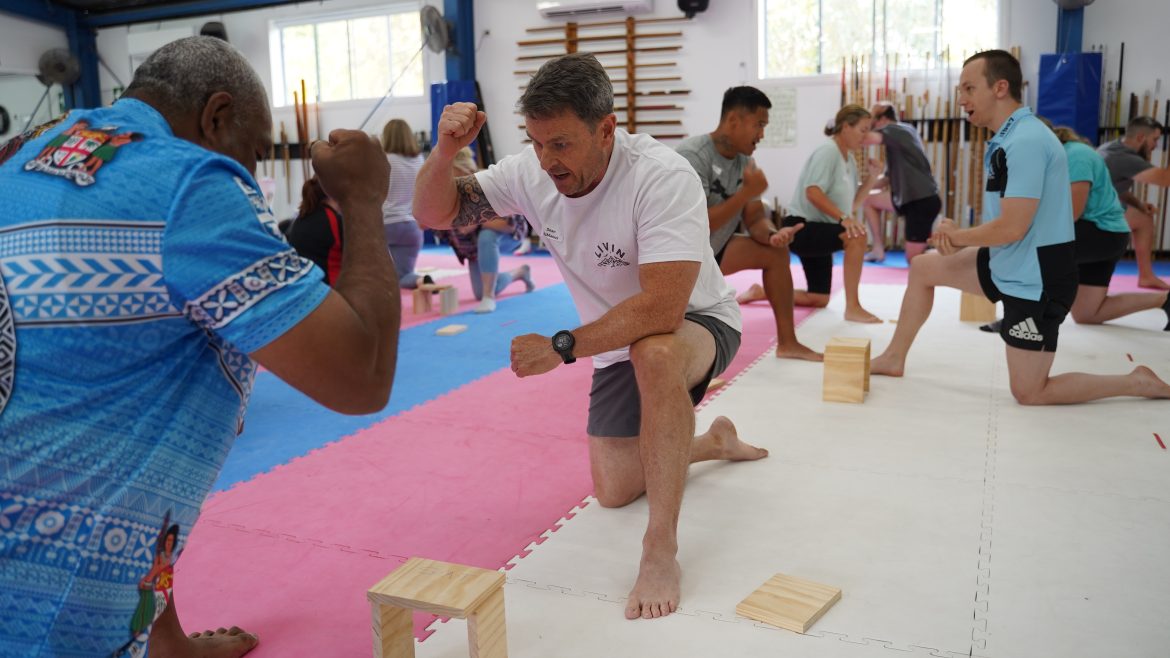
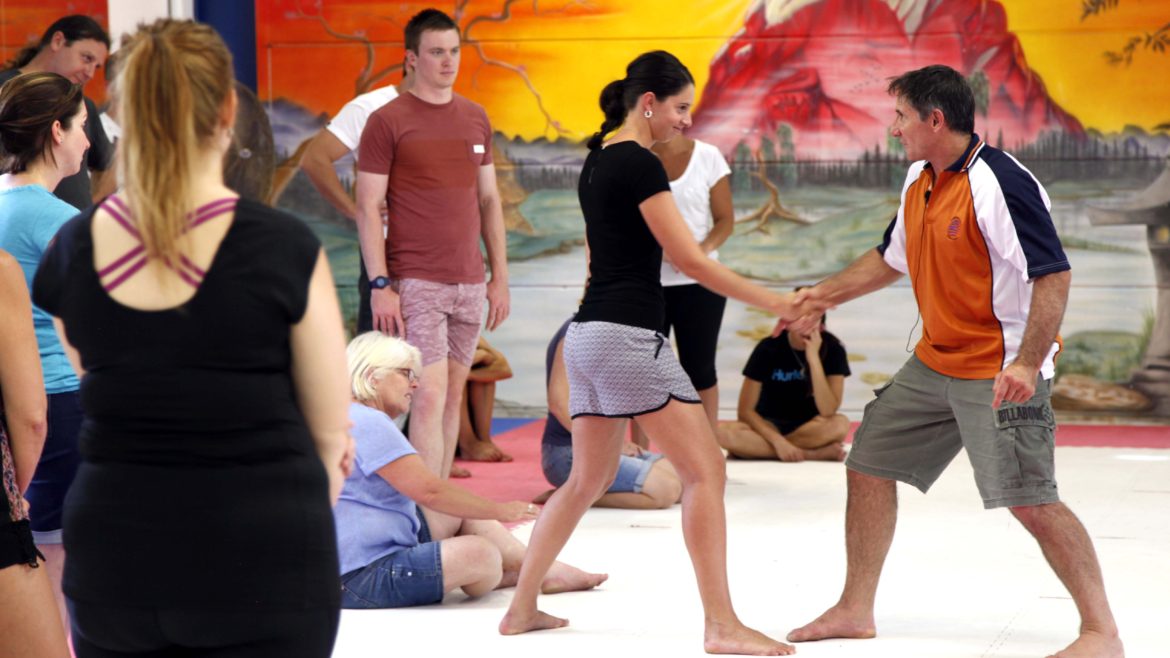
Evans River High Hosts Rock and Water
Workshops this year have been quite successful, with some notable new venues and some emerging champions of the Rock and water program.
Craig Gillespie at Evans River High has been teaching Rock and water for a long time. When I was a Deputy Principal at Waratah Technology Campus in Newcastle, back in 2000 and 2001, I shared a challenging group of Year 10 boys with Craig. Friday afternoons was a critical time for these restless boys, and since I was the person these boys invariably ended up with as they wore out their welcome in the classroom, we decided to hold Rock and Water sessions on a Friday afternoon. It sounds like a good way to guarantee failure for the program, but we recognised the challenge and set our lessons accordingly. They were very physical, and sometimes the boys would stop for a break, exhausted after rounds of high intensity exercise, and gasp, “Sir, can we take a break and talk for a while. We’re stuffed!” Of course, we were looking for just that, and Craig and I would then do some mindfulness exercises, or talk about their trials at school or in their family lives. This may not be the best formula for a Rock and Water program (I always advise to do the lessons in the mornings), but at our school, with these boys, I daresay it saved a few suspensions on Friday afternoons. Of course, we also held a morning class for this group that ran on a more conventional RW lesson plan.
I must say I was delighted when Craig called two years ago and offered to host a three day workshop at his new school at Evans Head where he had accepted the role of Head Teacher. We agreed that if the school hosted a workshop every two years, Craig would be able to put enough teachers through the training to ensure the program could be sustained at the school. I love to do workshops at Evans River High school. The catering is first class and provided by the school canteen. The venue is clean and roomy, and the staff know why we are there and are supportive. To ensure that the program becomes part of the school culture, Craig has booked me to conduct a One Day Workshop with the whole staff, so that he can promote a common language in the school around RW principles.
This is a great example of how to take a powerful program like Rock and Water and ensure that it is enshrined in school culture. Craig knows he will have enough trained staff to do what I call an inoculation program. This is where all of, say, Year 7 do at least a ten lesson program, ensuring all students 7-10, after 4 years, will understand thoroughly how to stand strong, speak up, respect boundaries, walk away from conflict, and support each other in these things. They will have the skills to make a choice about how they respond in times of difficulty. For students who need more support, he will have staff trained who conduct intervention programs for particular withdrawal groups, such as underachievers, or students who default to aggressive responses under pressure, or victims of bullying.
There are many schools in NSW, the ACT and in Tasmania that adopt a similar vision to the one exemplified at Evans River High School, and I look forward to describing their approaches in future blogs.